Medik Blog
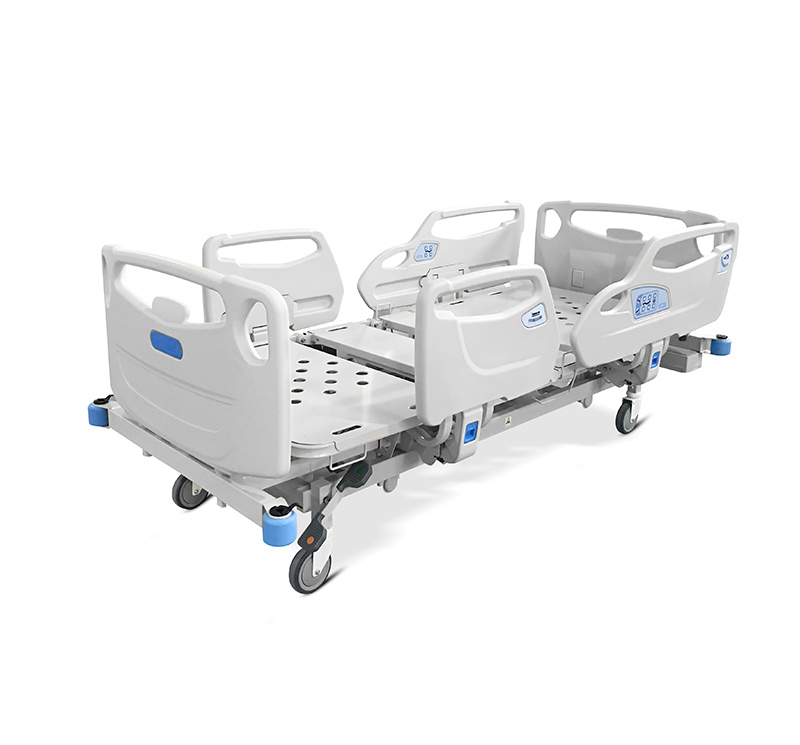
When choosing a hospital bed, it is important to understand that an ICU bed and a standard hospital bed are designed for different levels of patient care. Although both provide a safe and adjustable platform for patients, ICU beds are specifically developed for critically ill patients who require continuous monitoring, frequent repositioning, and access to medical equipment.
A standard hospital bed is generally suitable for patients with stable conditions who need routine inpatient care. An ICU bed, on the other hand, supports more complex clinical environments where rapid intervention and intensive nursing care are required.
What Is a Standard Hospital Bed?
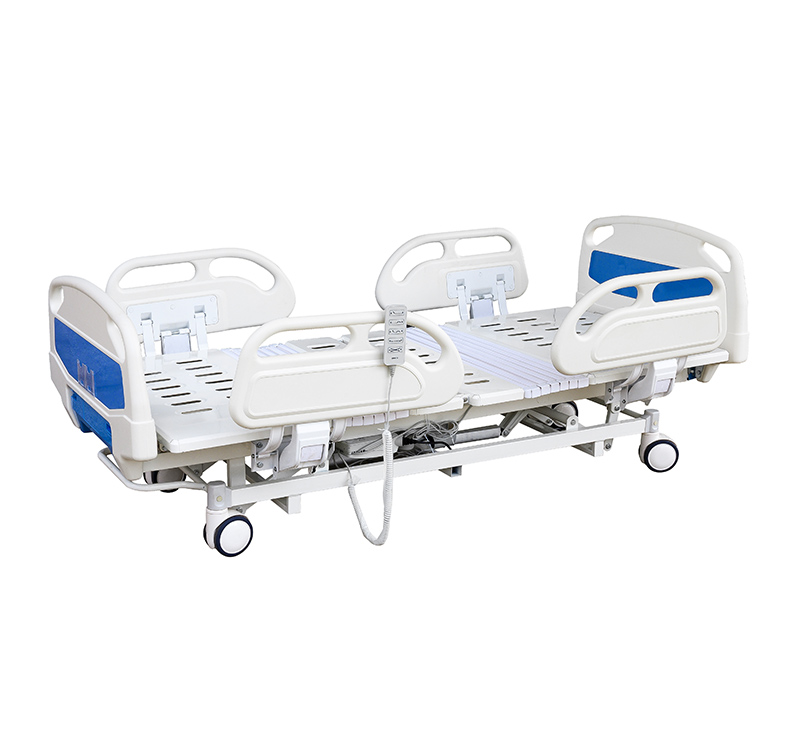
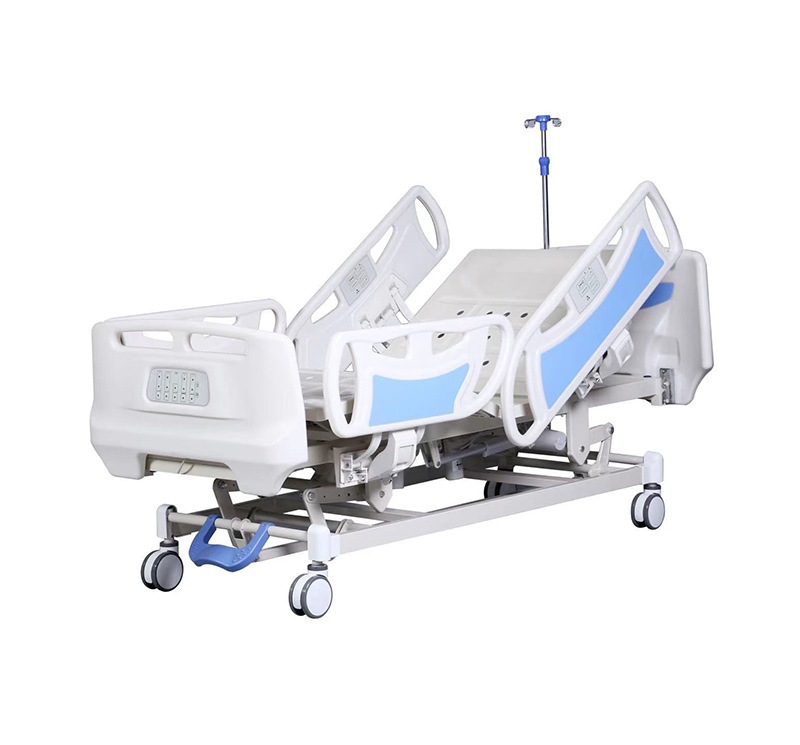
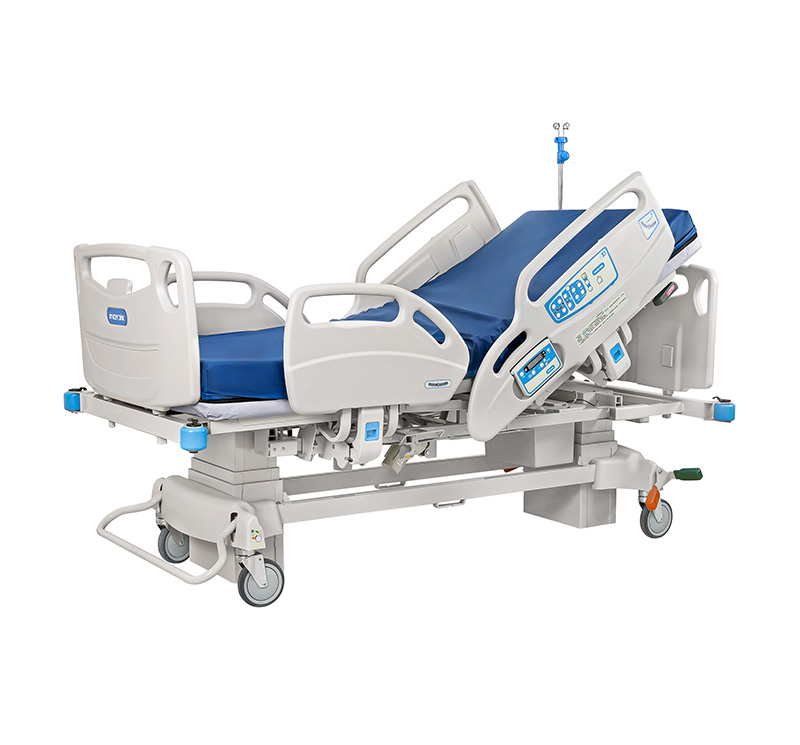
A standard hospital bed is designed for general inpatient care. It typically provides basic positioning functions, such as adjusting the backrest and leg section, and may include height adjustment depending on the model.
These beds are commonly used in:
• General hospital wards
•Medical and surgical wards
•Rehabilitation departments
•Long-term care facilities
•Some outpatient or treatment areas
The main purpose of a standard hospital bed is to provide patients with a safe and comfortable platform while allowing healthcare workers to perform routine nursing tasks.
Depending on the model, a hospital bed may include features such as:
•Adjustable backrest and leg section
•Manual or electric height adjustment
•Side rails
•Lockable casters
•IV pole
•Mattress platform
•Patient control panel
For patients whose conditions are relatively stable, these functions are usually sufficient for routine care.
What Is an ICU Bed?
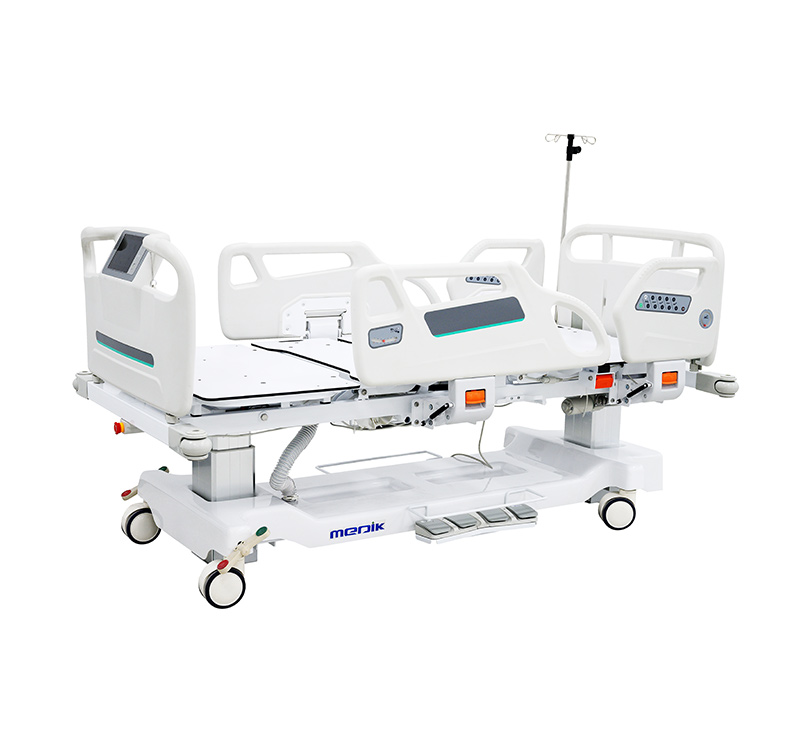
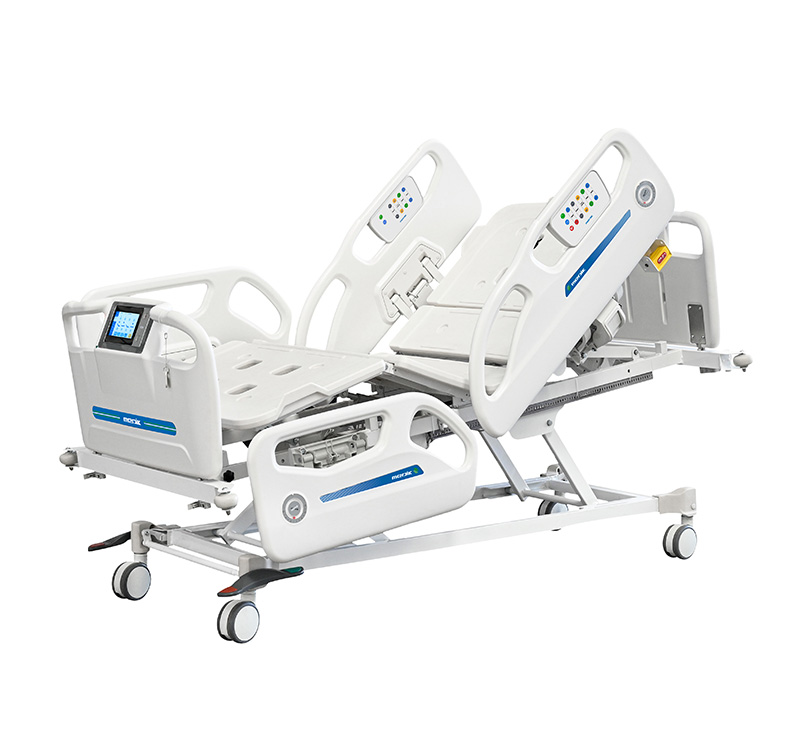
An ICU bed is specifically designed for intensive care environments. Patients in an intensive care unit may have unstable or critical conditions and often require continuous monitoring, frequent repositioning, respiratory support, and rapid access to medical equipment.
Because of these requirements, ICU beds generally provide more advanced positioning and safety functions than standard hospital beds.
Common ICU bed features may include:
•Multiple electric positioning functions
•Adjustable bed height
•Backrest and leg section adjustment
•Trendelenburg and reverse Trendelenburg positions
•CPR positioning
•One-button CPR release
•Integrated side-rail controls
•Central locking system
•X-ray-compatible backrest platform on some models
•Patient weighing systems on some advanced models
•Integrated accessory holders
•Large casters for easier movement
The exact configuration varies between ICU bed models, so not every ICU bed includes all of these functions.
ICU Bed vs. Standard Hospital Bed: Key Differences
The main difference is not simply the number of functions. ICU beds are designed around the needs of critically ill patients and intensive nursing workflows.
| Feature | ICU Bed | Standard Hospital Bed |
|---|---|---|
| Intended use | Intensive care | General inpatient care |
| Patient condition | Critical or unstable | Generally stable |
| Positioning | Multiple advanced positions | Basic positioning |
| Trendelenburg | Common | Model-dependent |
| CPR function | Usually available | May not be available |
| Height adjustment | Usually electric | Manual or electric |
| Side-rail controls | Common | Model-dependent |
| Patient monitoring support | Designed for intensive care equipment | Basic equipment support |
| X-ray access | Available on some models | Less common |
| Mobility | Designed for frequent movement | Routine ward movement |
| Nursing requirements | High | Moderate |
| Cost | Generally higher | Generally lower |
1. Positioning Functions
Positioning is one of the most important differences between an ICU bed and a standard hospital bed.
A standard hospital bed usually provides basic adjustments that allow patients to sit up, raise their legs, or adjust the overall bed height.
An ICU bed usually provides a wider range of positions. These may include:
•Backrest adjustment
•Knee or leg adjustment
•Overall height adjustment
•Trendelenburg
•Reverse Trendelenburg
•Cardiac chair position
•CPR position
These positions can help healthcare professionals manage patients who require more complex care.
For example, the Trendelenburg or reverse Trendelenburg position can be used when clinically appropriate, while rapid CPR positioning allows healthcare professionals to quickly prepare the patient for resuscitation.
2. CPR and Emergency Functions
Emergency response is another important consideration.
In an ICU, healthcare professionals may need to respond rapidly when a patient's condition changes. An ICU bed may therefore include a dedicated CPR release mechanism that allows the backrest to quickly return to a flat position.
Some models also provide controls on the outside of the side rails so that nurses can access key functions without reaching across the patient.
A standard hospital bed may not require the same level of emergency functionality because it is primarily intended for routine inpatient care.
3. Access to Medical Equipment
ICU patients often require several medical devices simultaneously.
Depending on the patient's condition, equipment around the bed may include:
•Patient monitors
•Infusion pumps
•Syringe pumps
•Ventilators
•Oxygen equipment
•Suction equipment
•IV lines and accessories
ICU beds are therefore often designed with accessory mounting points and structures that make it easier to organize equipment around the patient.
This is particularly important because the bed needs to work as part of a larger intensive-care environment rather than as an isolated piece of furniture.
4. Mobility and Central Locking
Both ICU beds and standard hospital beds may have lockable casters, but ICU beds often place greater emphasis on mobility.
An ICU bed may need to be moved quickly within the ICU or transported to another department for procedures or examinations.
Features such as:
•Central braking systems
•Larger casters
•Directional locking
•Push handles
•Fifth-wheel systems on some models
can make bed movement easier and more controlled.
However, the exact mobility system depends on the specific bed design.
5. Patient Safety
Patient safety is important for both types of beds, but ICU beds may provide additional features because critically ill patients can require more intensive monitoring and repositioning.
Common safety-related features include:
•Full-length or split side rails
•Lockable casters
•Low bed positions
•Emergency positioning
•Brake indicators
•Integrated control systems
Some advanced ICU beds also include an electronic weighing system or patient movement monitoring features.
These features are not necessarily required on every hospital bed.
6. X-Ray and Diagnostic Access
Some ICU beds are designed to allow certain diagnostic procedures to be performed without transferring the patient from the bed.
For example, an ICU bed may have an X-ray-compatible backrest platform or a design that allows imaging equipment to be positioned around the patient.
This can reduce unnecessary patient movement when a patient is too unstable to be easily transferred.
A standard hospital bed may not provide the same level of diagnostic access.
7. Price and Maintenance
ICU beds generally cost more than standard hospital beds because they incorporate more complex mechanical, electrical, and safety systems.
However, the purchase price should not be the only consideration.
Hospitals should also consider:
•Expected service life
•Maintenance requirements
•Availability of spare parts
•Warranty and technical support
•Ease of cleaning
•Replacement costs
•Staff training
•Compatibility with existing medical equipment
For general wards, purchasing advanced ICU beds may provide functions that are not necessary for routine patient care. Conversely, using a basic hospital bed in an intensive-care environment may not provide the functions required by clinical staff.
Can a Standard Hospital Bed Be Used in an ICU?
In general, a standard hospital bed should not automatically be considered a substitute for an ICU bed.
The appropriate bed depends on the clinical requirements of the ICU, hospital protocols, patient population, and equipment used in the department.
For a patient requiring intensive monitoring, frequent repositioning, emergency access, and multiple medical devices, an ICU bed may provide important advantages.
For stable patients receiving routine inpatient care, a standard hospital bed may provide sufficient functionality.
Therefore, hospitals should select the bed according to clinical requirements rather than simply choosing the bed with the largest number of functions.
How to Choose Between an ICU Bed and a Standard Hospital Bed
Before purchasing hospital beds, consider the following questions:
1. What type of patients will use the bed?
If the bed will mainly be used for critically ill patients, an ICU bed is more appropriate to consider.
2. How much positioning is required?
If staff frequently need Trendelenburg, reverse Trendelenburg, cardiac chair, or rapid CPR positioning, an ICU bed with these functions may be necessary.
3. What medical equipment will be used around the bed?
Consider whether the bed needs to accommodate infusion pumps, ventilators, monitors, oxygen equipment, or other accessories.
4. Does the hospital need X-ray access?
If bedside imaging is part of the clinical workflow, an ICU bed with an appropriate imaging-compatible design may be beneficial.
5. What is the hospital's budget?
More functions generally mean greater purchase and maintenance costs. Hospitals should balance clinical requirements with their available budget.
Conclusion
The difference between an ICU bed and a standard hospital bed goes beyond the number of electric functions.
A standard hospital bed is primarily designed for routine inpatient care and patient comfort, while an ICU bed is designed to support critically ill patients, intensive nursing procedures, emergency response, medical equipment integration, and more complex positioning requirements.
When selecting hospital beds, hospitals should first identify the needs of the department and patients, then choose the functions that are actually required.
The goal is not necessarily to choose the most advanced bed, but to choose a bed that provides the appropriate level of functionality, safety, mobility, and clinical support for its intended environment.
Reference
1.U.S. Food & Drug Administration (FDA) — Medical devices / hospital bed safety information
2.AHRQ (Agency for Healthcare Research and Quality) — Patient safety and hospital care resources
3.Joint Commission — Hospital and patient safety resources
4.IEC 60601-2-52 — Particular requirements for the basic safety and essential performance of medical beds
 English
 Française
 Español
 中文
中文